Coffee with COR-Featured Hot Shot
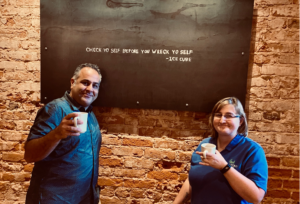
Pejman Mahdavi, LCSW, Director, Community CARE & Anne McMicken, LMSW, Community Connections Coordinator
Viewpoint Health is a community service board located in Georgia that provides services to individuals who need treatment and support to cope with mental illness, substance abuse, and intellectual and developmental disabilities. COR recently had the opportunity to interview Pejman Mahdavi and Anne McMicken about the importance of caring for those that care for others.
COR: Can you explain the involvement Viewpoint has had with the Department of Public Health during the COVID-19 response?
Pej Mahdavi: To give a little history, the involvement of Viewpoint during this response stemmed from the realization that mental health is a significant component of public health. I was deployed to Hurricane Dorian in 2019 on a Strike Team and that proved to our leadership team, and myself, how critical having an onsite mental health resource was in a public health response.
Anne McMicken: I have been involved with this response since March. My involvement has changed over the course of this pandemic. At first, my primary role was to provide emotional support getting tested for COVID-19. In the beginning, fear was palpable in both the healthcare professionals and patients. Since then, I have supported the Incident Command leadership team, served as a staff advocate, and provided counsel and emotional support for all staff.
COR: We believe you have had an overwhelming task in front of you, ensuring that the Department of Public Health associates and agency staff were emotionally supported during the pandemic. What approach did you take?
Pej Mahdavi: It was important that we placed the right mental health staff in this role. This person had to be approachable, adaptable, and willing to change course quickly. Our staff had to be able anticipate the needs of the next hour or day and not to focus any further than that. In a true emergency response, you need people that can think critically and shift with the need…a person that needs more structure honestly won’t be successful.
Anne McMicken: Crisis is where we THRIVE! Anyone that responds to a public health emergency has to recognize where they are needed to cover any gaps. I would change my approach on a daily basis depending on who needed me the most. At times it was the patient and other days it was the staff. I took it one day at a time and stepped in from there.
COR: It is a commonly known fact that healthcare professionals do not take part in self-care, what are a few basic tips that you share that healthcare workers can incorporate into their routine?
Pej Mahdavi: First and foremost, you have to CALL THEM OUT… Secondly, we had to CHANGE THE CULTURE. It was imperative that emotional support was needed. We were challenged to ignite the healthcare workers to be engaged. We did this by drawing parallels and helping remove the stigma of self-care. The old school way of thinking is a real phenomenon on any leadership team. The mantra: “Come to work and get it done”, is not sustainable in a long-term emergency response. We recruited a few “first followers” from the leadership team to engage and flipped the culture in order be successful.
Why wouldn’t you take care of your mental health like you would take care of something like diabetes?-Pej
Anne McMicken: Healthcare workers have to make self-care and emotional wellness a habit. Leaders have to lead by example and what keeps one person motivated is not necessarily what keeps others motivated. Once a leader recognizes this individuality it becomes much easier to spark the team. One leader within the response, Kim Pickens, stood out to me. She was a constant advocate for her team and placed their mental health as a top priority. It comes down to individuals recognizing they need to focus on their emotional health and the good news is that it is never too late.

The COR Perspective:
We can’t lie, practicing self-care is hard. We found ourselves head down buried in the response trying to ‘build the plane while we were flying it’. That can be true in any crisis. But this is not a Code Blue that lasts an hour or even a hurricane response that lasts a few days. The COVID-19 response has pushed healthcare professionals like nothing else we have seen in our lifetime. We are thankful to Viewpoint for taking care of our patients, our fellow healthcare workers, and us.


